Stealth Antennas

As a han radio operator, you only dream about the perfect location to operate from and where you can have the best antennas in the world, but most of us live in the real world with all of its restrictions. Here are articles about a couple of what I call stealth antennas, antennas disguised so that you would not think of them as an “ugly” ham anteena. Of course, to a ham, no antenna is ugly!

 Here is a link to an antenna system that you can hide in your front flower garden. Built using a flower pot, this antenna system can be deployed almost anywhere in the garden allowing you to operate some of your favourite bands.
Another stealth system used is to hide your antenna inside what looks like a flagpole. You can be patriotic at the same time as you will be able to work the ham radio bands that this antenna covers. The neighbours will be none the wiser!

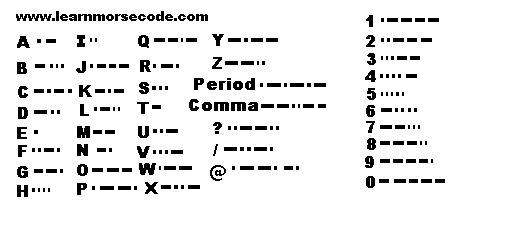
 This is the type of key most hams would start out using. The action of the key is up and down, when down, the contact is made and the transmitter turns on and transmits a CW signal. Your wrist (fist) gets tired fairly quickly when you use this key so other more user friendly devices were created to send the dots and dashes.
 I find this device called a keyer paddle much easier to use once you are used to it. Pressing the left side will send dots and pressing the right side will send dashes. A keyer is an electronic device which is in between the keyer paddle as shown and your transmitter and produces a dot when you press the left side of the paddle and a dash when you press the right side of the paddle. One advantage of the keyer paddle is that the keyer will produce either dots or dashes as long as you press the left/right side of the paddle. This is a commercial keyer paddle from
  If you want to save money, then you can build your own keyer paddles out of common paperclips. Here is a
  I have had my ham license since 1965, a period of 45 years (in 2010). In that time, my interests within ham radio have varied. In the beginning, you concentrate on learning the code so that you can get your license, then study some more so that you can get the Advanced license. Once you have accomplished these, then exam writing is over and you can do what you wish to do within the limits of the license.
 One of my biggest interests in ham radio is DX. DX is looking for and working stations far away from you around the world. When I lived in London, Ontario, I put up a 48 foot tower, with a tri-band beam and tried to work the world. I made many contacts with this setup in the years that it was up. My first DX contact with this setup was into the Canal Zone. i have worked (i.e. had a contact with) over 100 countries as well, and well remember one afternoon working many stations on 15 meters when sunspot conditions were better. That was a great afternoon!. One other great memory from my DX days is going to Antigua on vacation in 1981 and operating from there. I borrowed a radio and 2-element beam from a fellow ham there and made many contacts during that week. What an eye-opener to be on the other end of a pile up!
 One of my other interests now later in my ham life is QRP. With QRP, you use whatever receiver you like, but, to be considered a QRP contact, you must use 5 watts or less in transmit power. When you do this, your overall antenna system becomes much more important than if you are using more power. A lot has been and can be accomplished with QRP but you must realize that is not quite as easy as using more power.